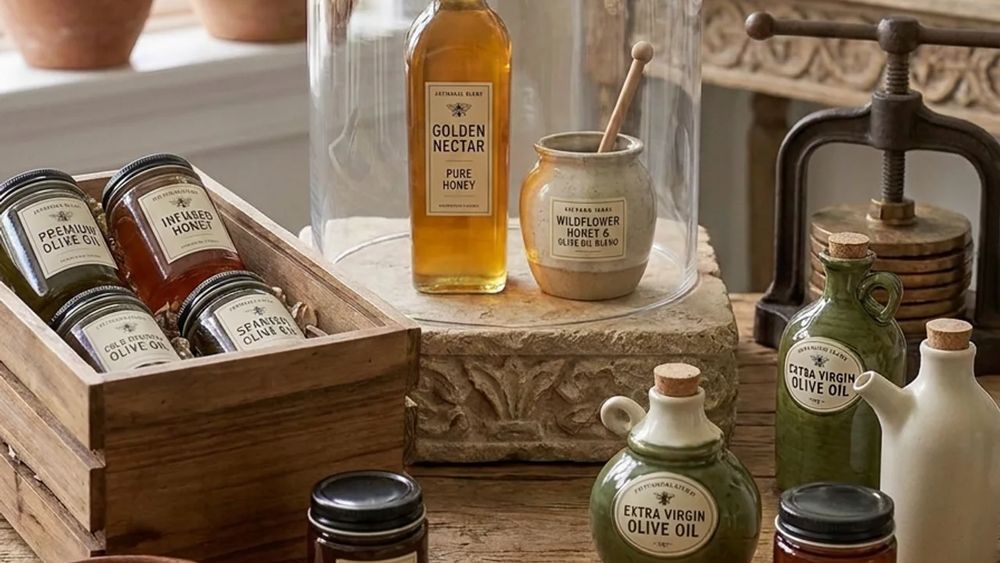
An editorial note on two foods older than most written records
A three-minute read about one shelf in an old kitchen, the two staples that never left it, and the quiet morning habit some readers say they borrowed from a slower way of setting the table.
Old World Pantry·Culinary History·Table Traditions·Kitchen Notes·Educational Content·Old World Pantry·Culinary History·Table Traditions·Kitchen Notes·Educational Content·
Old World Pantry·Culinary History·Table Traditions·Kitchen Notes·Educational Content·Old World Pantry·Culinary History·Table Traditions·Kitchen Notes·Educational Content·
The shelf, then the habit
Some shelves have been holding the same two jars for a very long time
Walk into an old Mediterranean kitchen and the arrangement is almost predictable. A bottle near the table. A jar beside it. Neither one was chosen for novelty. They stayed on the shelf because the shelf was where the day started, and because whoever set that table reached for the same two things without thinking about it.
What follows is an editorial note on that arrangement — where those two staples come from, how long they have been written down, and what some readers describe when they try to rebuild a slower morning around them.
Olive oil
Pressed from the fruit of trees that can stand for generations, it moved around the Mediterranean in clay jars long before it moved in glass. It appears in some of the oldest written records we have — inventories, trade lists, household accounts — which is another way of saying people bothered to write it down because it mattered on the table.
Old world staple
Honey
Gathered from wild nests long before anyone kept a hive, it shows up in cave paintings and in some of the earliest texts left by several different cultures. It is among the oldest foods still sitting in an ordinary kitchen, in a jar that would look entirely at home on a very old shelf.
Old world staple
What two of the oldest pantry staples have in common
Two very different foods, two very different origins, and one shared trait that explains why both survived every change the kitchen went through.
How an ordinary kitchen shelf can carry a very long history
The editorial follows a single shelf: what was placed on it, in what order, and why the arrangement barely changed across centuries of otherwise busy kitchens.
Why starting small tends to stick longer than a full overhaul
In habit journals, some people write that the version of a routine they kept was always the smaller one — the one that fit into a morning that was already crowded.
What editorial notes suggest about setting the table the night before
An old habit with a very practical logic: readers describe that the decision made at night is the one that removes the friction from the next morning.
The full editorial
The rest of the note is a short read
It covers where the two staples came from, how the shelf was arranged, and the ten-minute morning some readers describe rebuilding around it. No equipment, no shopping list, nothing to memorize.
Educational and historical content · Adult readers
Privacy Policy
This policy explains what information is collected when you visit this website, how that information is used, and the choices available to you. By using this site, you agree to the practices described here.
Information collected
Two kinds of information may be collected. The first is technical and is gathered automatically as you browse: browser type, device type, operating system, approximate region, referring page, pages viewed and time spent on the site. The second is information you choose to provide yourself, such as an email address submitted through a form. Providing that information is always voluntary.
How information is used
Information is used to operate and improve the site, to measure how pages perform, to understand which content readers find useful, and to deliver and evaluate advertising campaigns. Aggregated and anonymized data may be used for statistical analysis.
Cookies and similar technologies
This site uses cookies, pixels, tags and similar technologies to remember preferences, measure traffic and attribute visits to advertising sources. Most browsers allow you to refuse or delete cookies through their settings. Disabling cookies may affect how parts of the site function.
Sharing with third parties
Information is not sold. It may be shared with service providers that operate on our behalf, such as hosting, analytics, email delivery and advertising platforms, and only to the extent needed to perform those services. Information may also be disclosed when required by applicable law or to protect the rights, safety and property of the site operator or of third parties.
Sensitive information
This site does not knowingly collect, request or infer sensitive information about visitors. That includes religious belief, health information, biometric data and any other special category of personal data. Content published here is not targeted at any group defined by such characteristics.
Your rights and choices
Subject to applicable law, you may request access to the personal information held about you, ask for corrections, request deletion, or object to certain uses. You may also opt out of marketing communications at any time using the unsubscribe link included in every email. Requests can be sent through the contact page.
Data security
Reasonable technical and organizational measures are used to protect information against loss, misuse and unauthorized access. No method of transmission or storage is completely secure, and absolute security cannot be guaranteed.
Adult audience
This site is intended for an adult audience and is not directed to children. Information is not knowingly collected from minors. If you believe a minor has provided information, please make contact so it can be removed.
Changes to this policy
This policy may be updated from time to time. The revised version becomes effective when it is published on this page, and continued use of the site after publication indicates acceptance of the update.
Terms of Use
These terms govern access to and use of this website. By browsing this site you accept them in full. If you do not agree with any part of these terms, please stop using the site.
Permitted use
You may read, share and reference the content published here for personal, non-commercial purposes. You may not copy, republish, resell or redistribute the content for commercial gain, scrape the site by automated means, attempt to gain unauthorized access to any part of it, interfere with its normal operation, or use it in any way that violates applicable law.
Intellectual property
All text, layout, graphics, code and other material published here is protected by intellectual property law and remains the property of its respective owners. Nothing on this site grants a license to use any protected material beyond the permitted use described above.
Affiliate links and third-party sites
This site publishes sponsored content and may include affiliate links. The site operator may receive compensation when a visitor clicks a link or completes a purchase. Links to external sites are provided for convenience only. Those sites are governed by their own terms and privacy policies, and the operator of this site has no control over and accepts no responsibility for their content or practices.
Nature of the content
The material published here is educational and editorial. It discusses food history, kitchen traditions and everyday routines in a historical and cultural context. It is not medical, nutritional, legal or financial advice, and it is not intended to diagnose, treat, cure or prevent any condition. References to old traditions describe how people have used foods over time and make no claim about any effect on any person.
Professional consultation
Before making any decision related to health, diet or routine, you should consult a qualified professional who can evaluate your individual circumstances. Nothing published here replaces that consultation, and nothing published here should be used to delay or disregard professional guidance.
Disclaimer of warranties
The site and its content are provided on an as-is and as-available basis, without warranties of any kind, express or implied. No warranty is given that the content is accurate, complete, current or fit for a particular purpose, or that the site will be uninterrupted or error free.
Limitation of liability
To the fullest extent permitted by law, the site operator is not liable for any direct, indirect, incidental, consequential or special damages arising from the use of, or the inability to use, this site or the content published on it, including decisions made in reliance on that content.
Changes to these terms
These terms may be revised at any time. The current version is the one published on this page, and continued use of the site after a revision indicates acceptance of it.
Governing law
These terms are governed by the laws applicable where the site operator is established, without regard to conflict of law rules. Any dispute arising from them will be handled by the competent courts of that jurisdiction.